
In Canada, passenger and crew declaration procedures vary depending on whether a business aviation flight is operated on a private (non-commercial) or commercial basis. This distinction determines whether CANPASS, Advance Passenger Information (API), Passenger Name Record (PNR), and Passenger Protect requirements apply.
This article provides an overview of Canadian declaration procedures and clarifies which process applies to which type of operation.
Procedures for Private (Non-Commercial) Flights
Private, non-commercial flights are handled under the Canadian Passenger Accelerated Service System (CANPASS). CANPASS is a Canada Border Services Agency (CBSA) program designed to streamline customs and immigration clearance for travellers arriving on private and corporate aircraft.
Before arrival in Canada, the pilot or operator must contact the CBSA Telephone Reporting Centre (TRC) at least two hours before arrival and no more than 48 hours in advance. During this call, CBSA will typically collect:
- Aircraft details (registration and type)
- Flight routing and estimated time of arrival
- Airport of entry
- Names, dates of birth, and citizenship of passengers and crew
- Purpose of travel
- Confirmation that the flight is private and non-commercial
Based on this information, CBSA determines how clearance will be handled on arrival. After landing, the pilot is required to contact CBSA again to confirm arrival and report any changes from the original declaration.
Before operating to Canada, flight crews must also ensure that all required cross-border documentation is carried on board. Transport Canada publication TP 15048 outlines the pilot and aircraft documentation requirements applicable to international operations.
Commercial Business Aviation
When a flight is operated on a commercial basis, Canadian authorities treat the operator as a commercial air carrier. In these cases, pre-departure passenger data submission and aviation security screening obligations apply in full.
Commercial business aviation operators must comply with two parallel regulatory regimes:
- CBSA Advance Passenger Information (API) and Passenger Name Record (PNR) requirements for border control and immigration assessment
- Passenger Protect Program (PPP) requirements for aviation security screening under the Secure Air Travel Act
CBSA API and PNR for Commercial Business Aviation
API submission
For inbound commercial business aviation flights to Canada, API must be transmitted for all passengers and crew prior to departure.
The required API dataset includes biographic and travel document information such as full name, date of birth, gender, nationality, travel document type and number, issuing authority, and relevant flight details. CBSA processes this information through its Interactive API (IAPI) system to assess documentation validity and immigration risk before boarding.
Timing requirements are strict:
- Passenger API must be transmitted no later than check-in
- Crew API must be transmitted no later than one hour before departure
- Any changes to passenger or crew details require an updated transmission prior to departure
- After take-off, a close-out message confirming who actually boarded must be sent, typically within 30 minutes
- Outbound commercial flights from Canada are also subject to API requirements and must be transmitted prior to departure.
CBSA results are returned electronically for each passenger to Carriers. Operators must comply with any instructions related to the status received, including preventing boarding where required.
PNR submission
For operators who utilize an automated reservation system or a Departure Control System (DCS), Passenger Name Record (PNR) requirements apply separately and only to inbound flights. BA/GA operators are exempt from these PNR obligations, as they do not use these automated systems.
When PNR is due, CBSA expects a single, accurate PNR transmission at the time of departure from the last point of embarkation before arriving in Canada. PNR data is not required for outbound flights.
Passenger Protect Program (PPP): Security Screening for Commercial Business Aviation
Commercial business aviation flights are also subject to aviation security screening under the Passenger Protect Program (PPP), administered pursuant to the Secure Air Travel Act (SATA).
These obligations apply to passengers travelling on commercial flights to, from, or within Canada (domestic).
Under the Secure Air Travel Regulations, carriers must first transmit passengers identity information from 72 hours before scheduled departure and as soon as a new passenger is booked or amended within that 72-hour window.
Screening results are returned electronically for each passenger to Carriers. Operators must comply with any instructions related to the status received, including preventing boarding where required.
Interpreting Passenger Status from CBSA & PPP
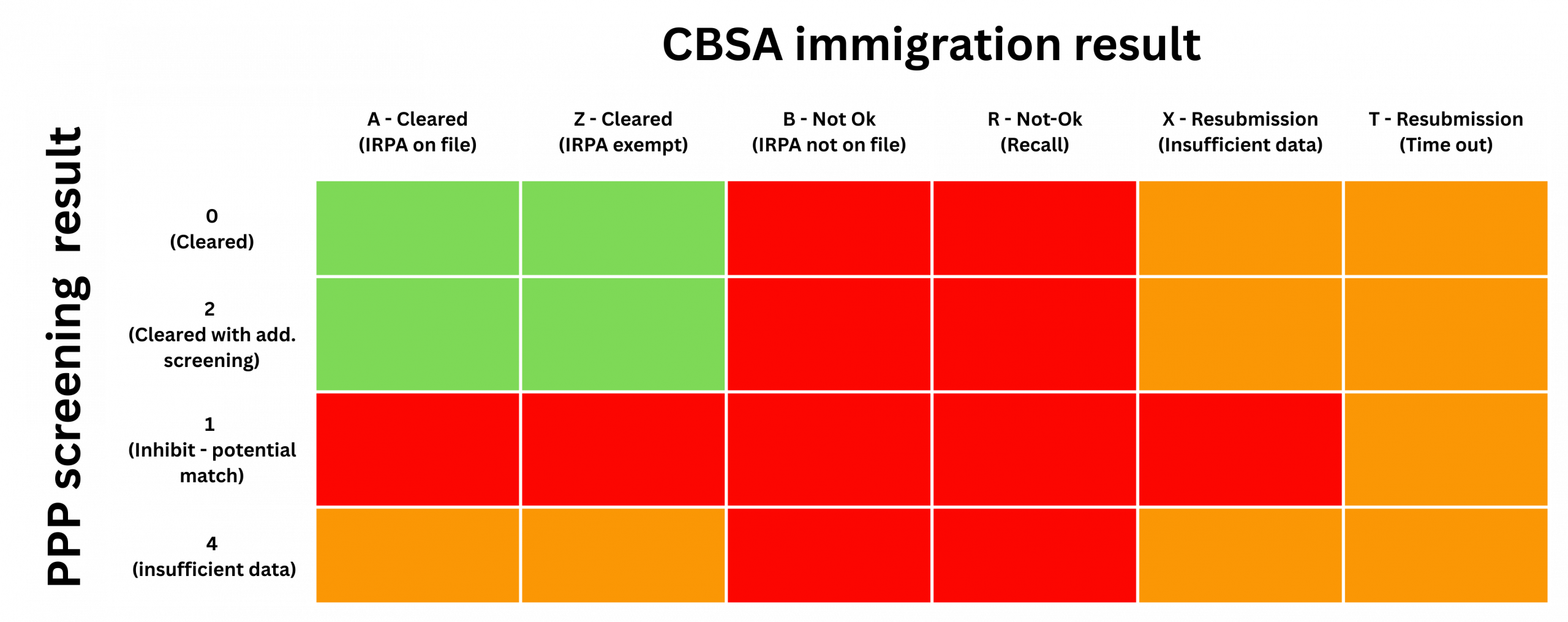
Carriers receive a combined passenger status reflecting both CBSA immigration clearance and Passenger Protect screening results.
Each status consists of:
- One numeric digit (0, 1, 2, or 4) indicating the Passenger Protect result
- One letter (A, Z, B, R, X, or T) indicating the CBSA immigration result
CBSA Status Codes
- A – Prescribed IRPA travel document on file
- Z – Cleared; exempt from prescribed IRPA travel document requirements
- B – Prescribed IRPA travel document not on file
- R – Recall of code A or Z (issued as an unsolicited message)
- X – Insufficient data to determine immigration result; resubmission required
- T – Time-out; CBSA immigration result unavailable; resubmission required
Passenger Protect Status Codes
- 0 – Cleared
- 1 – Inhibit; passenger is a potential match to the SATA list
- 2 – Cleared with additional screening
- 4 – Insufficient data to perform screening; resubmission required
Whether a carrier receives an OK to board, not OK to board, or a request for data resubmission depends on the combination of these codes, as demonstrated in the schema below:
Automating Canadian Passenger Data Compliance with Streamlane
Streamlane helps business aviation operators transform complex passenger and crew data requirements into a streamlined and reliable process. Passenger and crew information is captured and automatically transmitted to the relevant Canadian authorities in the correct format and within required timeframes.
In addition to automated transmissions and updates, return statuses are delivered directly within the operator’s flight management system. Integrated intelligence layers help operators interpret responses clearly and make informed boarding decisions.
By replacing manual, error-prone processes with automation, Streamlane eliminates regulatory risk, improves operational efficiency, and ensures consistent compliance with passenger and crew submission requirements.